
Image from Isha Kannan.
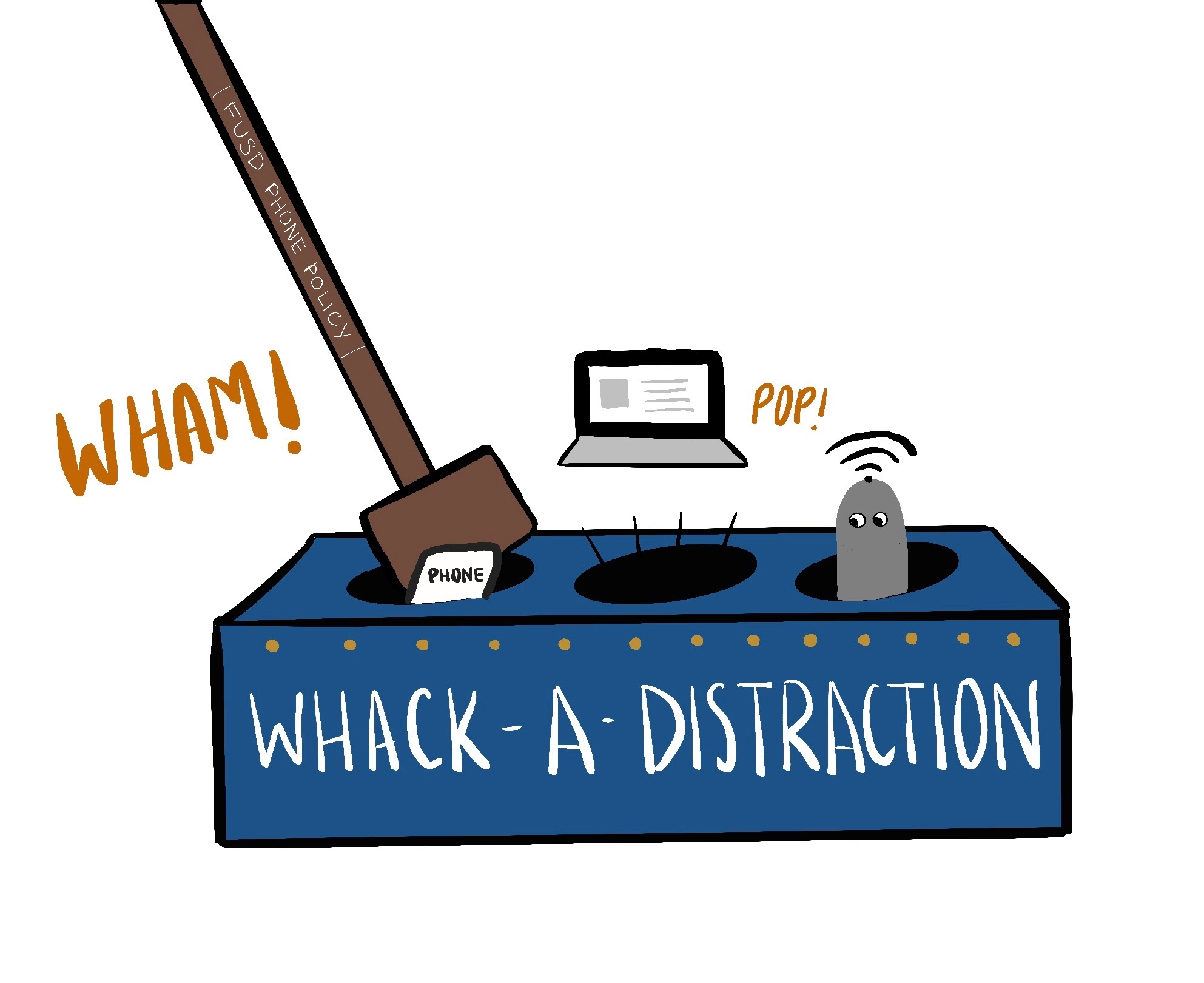
Almost half of American teenagers report feeling anxious when they don’t have access to their phone. This year, FUSD students go through most of the school day without theirs. While the new FUSD technology policy attempts to reduce classroom distraction, banning phones while encouraging the use of technology like Chromebooks raises a harder question: is it enough just to restrict the use of phones, or does the policy miss the bigger picture?
Under the new policy for smartphone use, required by California Assembly Bill 3216, students must switch off or silence phones during lessons. They may use phones, smartphones, and smart devices in school only before school, during lunch, and after school. Some exemptions apply, such as emergencies, health issues, IEPs or 504 plans, and teacher or administrator approval.
The teacher permission rule gives teachers the freedom to adjust the rules according to their classroom, making it difficult to maintain consistent policies across campus. Some teachers at Washington require phones to be placed in a pocket chart each class period, while others allow phones once students complete their assignments. Some subjects, such as journalism, personal finance, and leadership, actually require mobile phones to operate. Even so, most students’ routines haven’t changed much, since most WHS teachers already restricted phone use before the district’s official announcement.
This flexibility helps because teachers know their own classes best. However, it can confuse students about what to expect. For example, during flex time, while most teachers permit cell phones, some confiscate them. Students end up having to adjust to individual teachers.
More importantly, if the aim is to limit distractions, restricting phone use and allowing laptops simply shifts the distraction from one medium to another. A student who can’t use Instagram on their phone can use it just as easily on their laptop. To prevent this, some teachers prefer school Chromebooks that GoGuardian can control, letting them monitor student activity and shut down tabs, while others allow unrestricted use of personal laptops. Recently, however, the district restricted all personal devices from accessing Wi-Fi, perhaps to encourage greater use of Chromebooks. Nevertheless, students have found a way around it by connecting to hotspots and other Wi-Fi networks.
However, the restrictions do appear to be more successful than students admit. Many students found they didn’t miss their phones when they were put away. Some even argue that phones should be fully banned during class because it pushes students to interact and communicate with others. If the mere presence of a phone in a pocket holder is enough to make students more focused, then the rules may be accomplishing their intended purpose.
Another important question is whose interests the technology policies actually serve. Of course, the main goal is learning, since a classroom of students on their phones can’t engage in meaningful education. But part of it is also about making classrooms easier to manage. This isn’t necessarily a bad thing, because teachers need control of the room to teach. What matters is whether the rules help students learn, not just whether they keep the room quiet.
The debate over phones also points to a bigger question: how much of the school day actually needs a screen? The answer depends on the subject. Many students find that math, note-taking, and reading stick better on paper. Some students in AP Psychology say taking notes on their laptop is less useful, while others in AP World find it harder to understand material read online. Writing by hand helps you think and generate ideas without the distraction of a screen. On the other hand, typing is faster for writing and editing. You also can’t do research on the Internet without a computer, and large amounts of paper only add to waste. The problem isn’t screens themselves, but using them out of habit rather than purpose.
Whether the tool is a phone, a laptop, or a sheet of paper, the goal should be the same: using the right tool for learning. With that in mind, an effective technology policy does not need to be complicated. Phones stay away during instruction, with clear, consistent expectations across classes. Personal laptops have clear guidelines for classwork. Teachers who allow devices after a lecture or during flex communicate that clearly. Each class chooses between paper and screens based on what really helps students learn.
Ultimately, phone use in school is more a discipline issue than a technology issue. Students who want a diversion will find a way, and even students who want to learn can give in to being distracted by a device. No policy can solve that alone, but clear, specific rules are a strong place to start.