
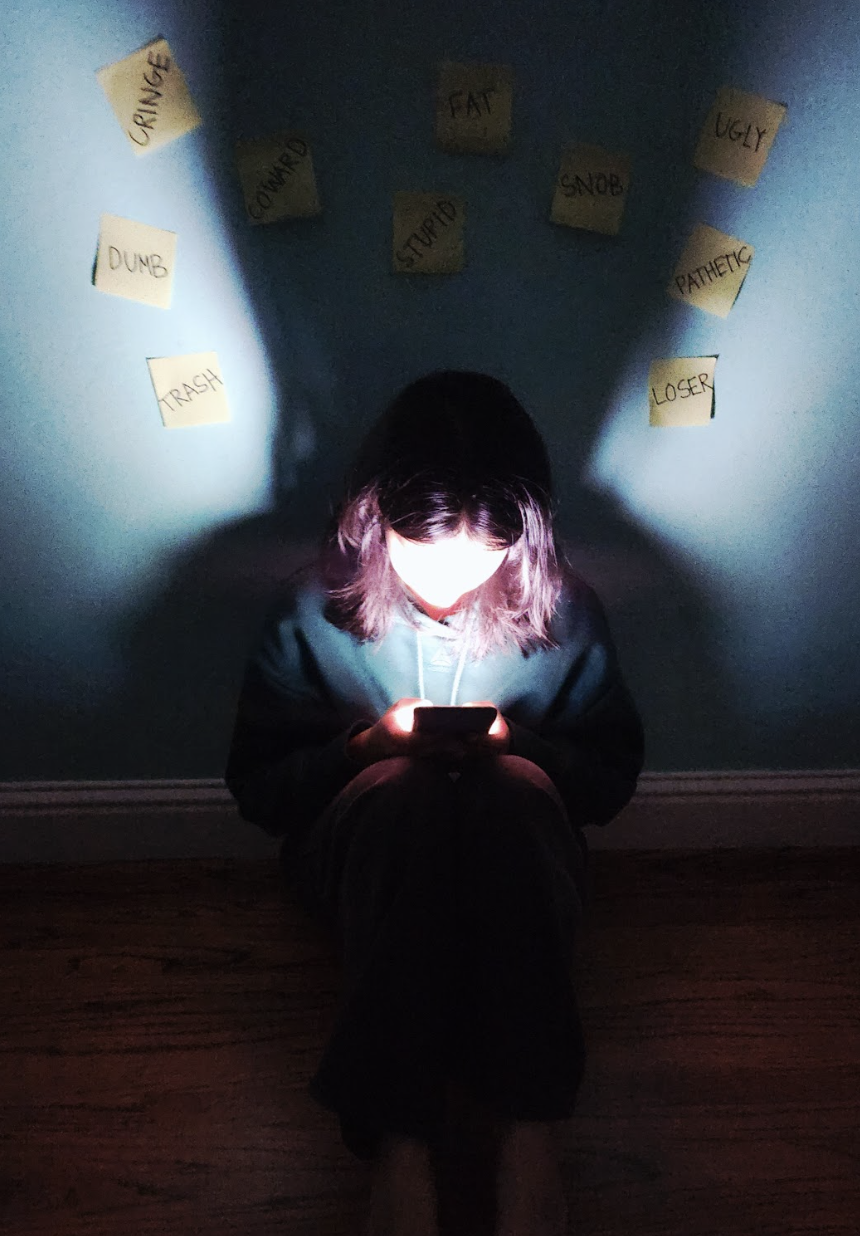
For one Washington sophomore, it started during COVID-19, when online spaces and social media became the main way to connect. People she called her best friends at the time would taunt her, commenting constantly about her appearance and sexuality, even going so far as to calling her slurs. “Sometimes you’re just made to feel like you should be ashamed of it,” the student, who wishes to remain anonymous, said. “I didn’t really tell anyone for a while because I didn’t want people to know that I let this happen.” She also mentioned being torn between telling someone and not wanting to get them in trouble because part of her felt like they were still her friends: “It was a hard pill to swallow. I call these people my friends because they’re all I’ve got, but I know they’re not.”
It wasn’t just limited to one social media platform; these disparaging comments happened on Tiktok and Discord and later carried through to real life when in-person school restarted at Centerville Jr. High. She started internalizing everything her “friends” said about her, which deeply hurt the way she saw herself. Even the most secure people can be affected, brought from being confident in their skin to second-guessing every part of themselves. “I just hope [people facing cyberbullying]know that it’s not their fault, because sometimes you get very lost in the feeling that ‘this is my fault.’‘I deserve it.’ Maybe they’re telling me I’m annoying, or maybe they’re making fun of how my body looks because my body is wrong.” She struggled to accept that people she trusted could treat her like this and started questioning whether their comments were true.
It came to the point where she didn’t want to go to school if it meant talking to the same people that had been sending messages the night before. Even her counselor brushed it off, leaving her virtually alone to deal with the insults.
Eventually, she started blocking people on Tiktok. She removed them from her life, making sure to stay away from anyone that made her feel bad about herself. She developed a clearer sense of her values and boundaries, saying “No matter how awful someone was or how mean someone is, there are lines I refuse to go over because people did that to me and I won’t do that to someone else.”
A second student, a junior who would also like to remain anonymous, experienced cyberbullying through social manipulation and rumors. A shared Instagram account posted pictures of people taunting him during freshman year, but only one of the authorized users was responsible for the posts. Although some of his close friends, who were also users of the account, deleted the posts, it was extremely difficult to take back what happened.
To make things worse, after this a fake story was created around the then freshman, and the rumors that came from it forced him to cut down his circle of friends from 20 to 6. Very few people stood by him while the rest believed the fabricated narrative being put out. “People who are different are still people,” he said. “You can have opinions but you don’t have to express them or get other people to join you to hurt others.” As a result, he became much more guarded, becoming more cautious of who he talked to and frequently wiping social media accounts of posts. “I lost [a lot of] friends within the span of 1 year,” he said. People that have experienced cyberbullying can lose entire support systems, while the perpetrator often gets off scot-free. For both of the students interviewed, the person or people doing the bullying didn’t receive any consequences.
Despite all this, he was able to stick with a close group of friends that helped him through mental health issues and have always been kind, supportive people. “Having some friends that will be there for you is very important because they essentially become your second family,” he says. That sense of belonging is incredibly important for people going through something similar. Having at least one friend to lean on can help ground them and remind them of their worth, especially when they feel alone in dealing with online bullies.
Not all cases of cyberbullying involve friends or people the victim already knows, but many experiences follow the same reality: a loss of trust, a change in self-perception, and not being heard by the people that should be there for you — whether it’s a friend, parent, or counselor. The unfortunate truth is that for many, the experience and feeling of not being enough stays with them long after the incident.
The best thing we can do to help victims of cyberbullying is to provide them with a safe space where they feel heard and taken seriously. A common factor in many experiences is being brushed off because the situation doesn’t seem “serious enough.” As the sophomore said, “We all just need to care a little more and that’s the easiest way to make it easier for people to talk about it.”

Tanishqa Kolekar is a junior at Washington High School and was born and brought up in Fremont. This is her first year at the Hatchet and she’s interested in writing about politics, as well as covering common school issues in a more humorous fashion. She enjoys reading, writing flash fiction and short stories, and developing video games in her spare time. In the future, Tanishqa hopes to be a cybersecurity professional or video game developer, although she’s painfully aware that aiming for a computer science degree could just leave her living in a nicely decorated tent.