
Image From Abby Truong
We may have missed the era of MySpace and early YouTube, but Gen Z was definitely there for an era of the internet. Holding our iPads in sticky fingers, we were treated to a front row seat for the rise of the monetized internet. Almost overnight, our favorite YouTubers shifted from being unremarkable content creators into big-box brands peddling merchandise in our local Target.
Suddenly, the internet was no longer a place of creativity; our social media sites had sold out, becoming yet another forum for profit. The quality of online content began to plummet; come 2020, our TikTok feeds have become flooded with 40-part movie clips, posted solely for a quick buck. I truly feel the for-profit internet has ruined the authenticity and entertainment value of online content. On the modern internet, creating for the love of the game is now unheard of— and it shows.
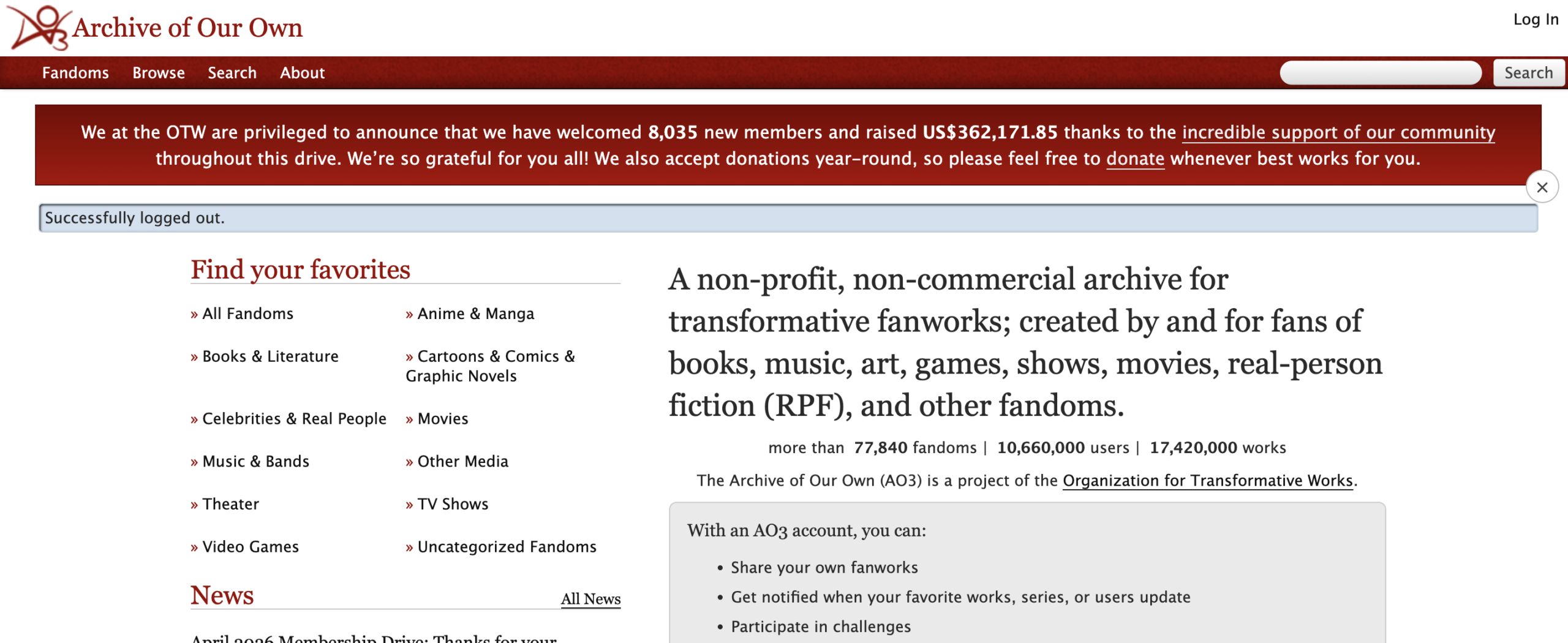
But there is a beacon of hope— an online wellspring of creativity where authors post content out of passion, for little to no external reward. This, dear reader, is fanfiction— a place where quality writing and hope spring eternal, solely for the entertainment of the reader—you.
I’ve always felt that we as a society should take fanfiction more seriously. We have this idea of fanfiction as a monolith; solely poor quality and often raunchy works that add little to no value to either the original work or our own lives. But this is simply untrue; I think in many cases, the length of a fanfiction, the labor of the author, and the quality of the work make a fanfiction deserving of the praise of your average novella. A famous Harry Potter fanfiction, “All the Young Dudes”, which focuses on the lives of the “Marauders” characters during the 70s (before the timeframe of the canon material), has created a world so distinct from the source material that it has garnered an online fanbase in its own right. Not only is “All the Young Dudes”, as an unofficial fanfiction, able to expand on the queer dynamics of the Harry Potter characters, a topic rendered taboo by its own author, it has also acted as a gateway to queer history for many of its teenage readers. “All the Young Dudes” serves as a time capsule of the queer experience of the 70s, portraying the fear, oppression, and often joy of its characters with a deftness that renders it, to me, deserving of (some) literary merit.
I mention this because the quality of “All the Young Dudes” is not entirely unique; there are countless quality “fics” online that make fanfiction worth examining as a worthy internet phenomenon, and a unique one at that. Fanfiction is a genuine outlier on the modern internet because there is virtually no gain from producing it. Nowadays, people who run active social media accounts (those that are not personal) are after three external motivators— fame, money, or intellectual validation. But publishing fanfiction reaps none of these rewards.
You can’t monetize fanfiction due to copyright reasons. Fame is also out due to the way fandom culture operates— your work is published anonymously, and you as a creator are only known under a pseudonym. It’s rare to receive widespread praise for your work, and impossible to build a public brand.
There’s genuinely no gain. There’s not even intellectual validation (of the substack variety) because fanfiction is mainly frowned upon. So why do people do it?
It’s purely for the love of the game. And since fanfiction is never created for external reward, they’re unable to do anything but to serve the original purpose of the internet: to connect. To connect the masses, sure, but also to connect more niche communities— strangers who would otherwise never interact with each other in public, but who come together to be entertained by some nonsense franchise, bringing just a little more joy into their lives.
In the 2020s, fanfiction is a modern unicorn in the sense that it caters to communities who often want to remain underground, rather than gain a wider audience.
This creates an echo chamber within fandoms, a phenomenon that you would think would lead to their detriment, but has surprisingly been anything but. While creators on the wider internet seem to be criticized for any minor flaw, the culture of fanfiction is resoundingly positive because of its underground nature; it’s understood any work is a passion project. For authors, it’s incredibly encouraging to write to an audience you know will receive your work positively; in fandom spaces, authors can be daring, experimenting with their writing and interpretations of the source material in ways they wouldn’t have been able to do in mainstream media.
Fanfiction is a culture that has grown entirely off positivity and passion for the craft. It’s an idealistic space that would never translate to larger communities, but I can’t help but wonder what the larger internet would be like if it held similar values. What could the internet be if people were slower to judge? If the “creator” fund was never invented?
Sadly, we will never know. We can ask all these questions, but the internet is never coming back. But we can still highlight creators who are carrying on the values of the early internet. Who are still doing it for the love of the game. Shout out to fanfiction authors—truly, nobody is doing it like you do.

Abby Truong is a senior at Washington High School and has lived in Fremont since birth. She hopes to spend her first year at The Hatchet covering local news and sharing her opinions. Apart from volunteering at the public library, Abby enjoys planning imaginary vacations and developing concepts for TV dramas. She hopes to attend a college in Boston and major in English on the pre-law track.