
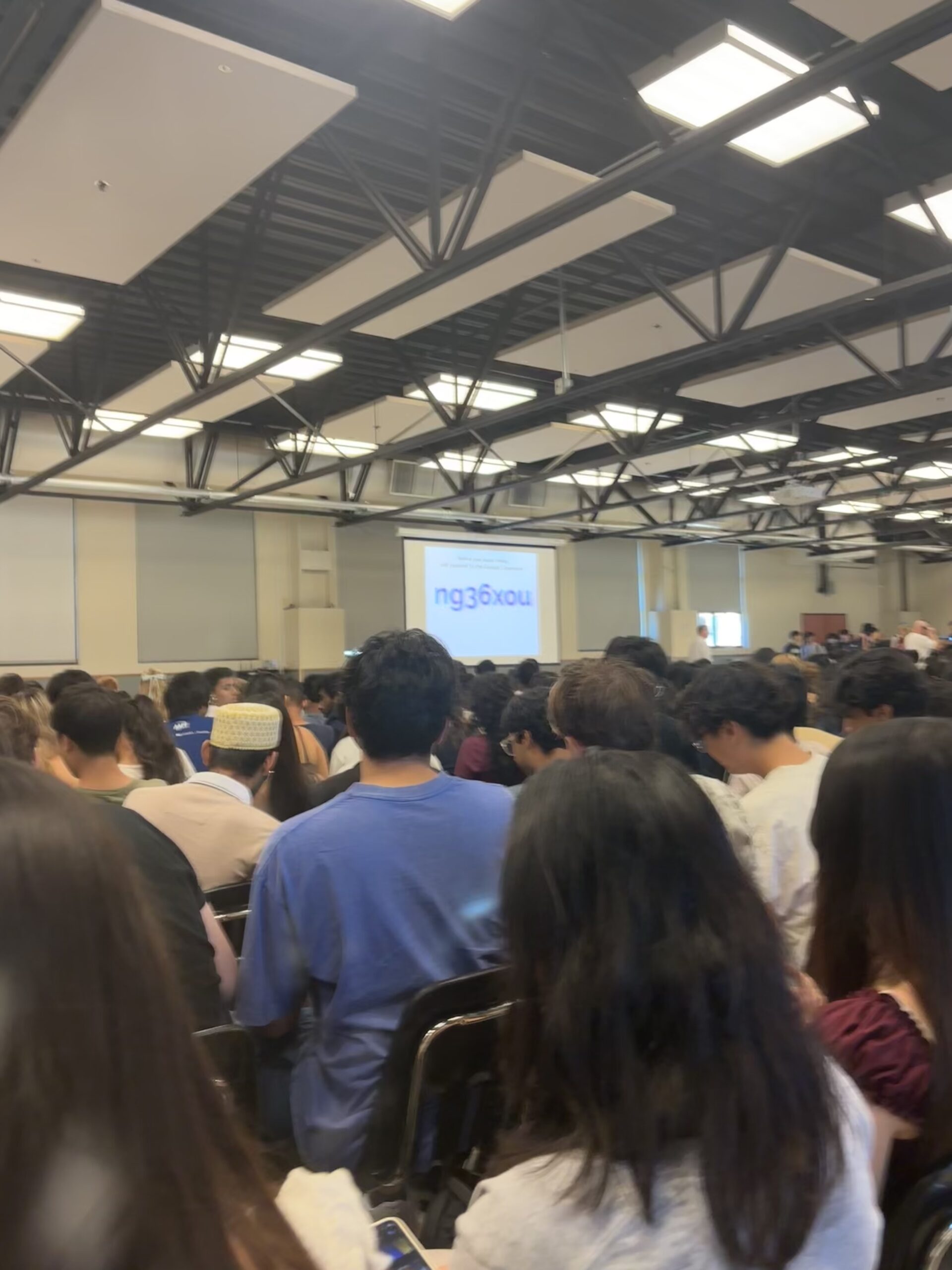
Image from Kavya Datt, Caption: WHS students cram into the cafeteria to see a presentation on AP registration information
At Washington High School, class sizes remain larger than ever despite ongoing concerns from both teachers and students. Each fall, hundreds of students are left scrambling for limited seats in AP courses, with waitlists for popular courses featuring dozens or even hundreds of students. Some are forced to resort to expensive online alternatives just to take classes they are interested in. For educators, the challenge lies in balancing rising enrollment with limited staffing and maintaining student engagement.
Teachers say that overcrowding makes it difficult to provide students with the individualized attention they deserve, especially in advanced and AP-level courses, which pack college-level material into a single year or semester. AP Psychology teacher Mr. Kim says, “It is rather difficult to really ascertain where everybody is at any given part of the day.” He adds, “Unless I’m having personal conferences, it’s tough to get every single person within a class session.” He also shares that every teacher has developed different methods for retaining the attention of 36, often distracted, adolescents.
Students are also feeling the strain of the system. “Since junior year, I’ve had to fight for AP classes just to get the schedule that matches the rigor and classes that I want,” said senior Sahasra Muthyala. She explained that she was placed in courses she didn’t request, given only two APs in her senior year. Eventually, she had to swap schedules with another student to access the classes she wanted, which had tight 34-student caps, a testament to how students are left scrambling for seats.
Leadership and economics teacher Mr. Soltau shares a similar view. “A large class size to me is not necessarily a number,” he says. “Is it possible to reach everybody and give them the one-on-one time if they need it? Would I like a class of 25? Yeah, who wouldn’t, right? Because then I can be more one-on-one. [But] that’s just not realistic.”
While educators have found strategies to cope, such as relying on technology or utilizing teacher assistants, there is only so much they can do. “Most of my assignments are Google Classroom-based, so it’s easier to manage,” said Mr. Soltau, explaining how deadlines become stricter as the number of students grows, to keep everyone on task.
Many hoped this year’s contract negotiations between the Fremont Unified Teachers Association (FUDTA) and the district would lead to class size reductions, a top priority for most teachers. Instead, the new contract does not impose any hard caps on class sizes at the high school level. Mr. Kim stated, “That was one of the big concessions that a lot of people were outraged by,” as it was a top-of-the-ticket item for many. Others acknowledge the system is stretched thin. To reduce class sizes, more sections would be required, which would necessitate more teachers, more classrooms, and significantly more funding. Mr Soltau says that everybody agrees on the problem. The issue lies in finding a solution.
The stakes feel even higher in the Bay Area, where academics and college admissions take up a lot of headspace. With many students aspiring to attend competitive, out-of-state universities, AP courses are seen as essential to applications. The pressure is particularly evident when students are unable to secure spots in classes and forced to turn to online alternatives, such as UC Scouts. These courses often come with price tags, raising further questions about equity in a supposedly “free” education system.
For now, both students and teachers are forced to adjust to the reality of crowded classrooms, long waitlists, and after-school meetings with the counselors and Mr. Moran. As demand continues to climb for popular courses, the question remains whether the district will find a way to balance resources or whether students will be left navigating an inequitable, pay-to-play system.

Kavya Datt is a senior at Washington High School, born and raised in the Bay Area, California. This is her first year writing for the Hatchet, and likes writing about global issues and community impact stories. Outside of journalism, she’s heavily involved with debate, a few clubs on campus, and a long time community volunteer. In her free time, she enjoys painting, reading, traveling, and binge-watching shows. In the future, she hopes to study something interdisciplinary in policy and global affairs, combining research and advocacy.